




By proceeding, I acknowledge that I have read and agreed to the Privacy Policy, Terms & Conditions, consent declaration, and the sharing of my information with lending partners, dealers, OEMs, and for marketing communication via Phone Calls, SMS & WhatsApp.


ADVERTISEMENT

ADVERTISEMENT







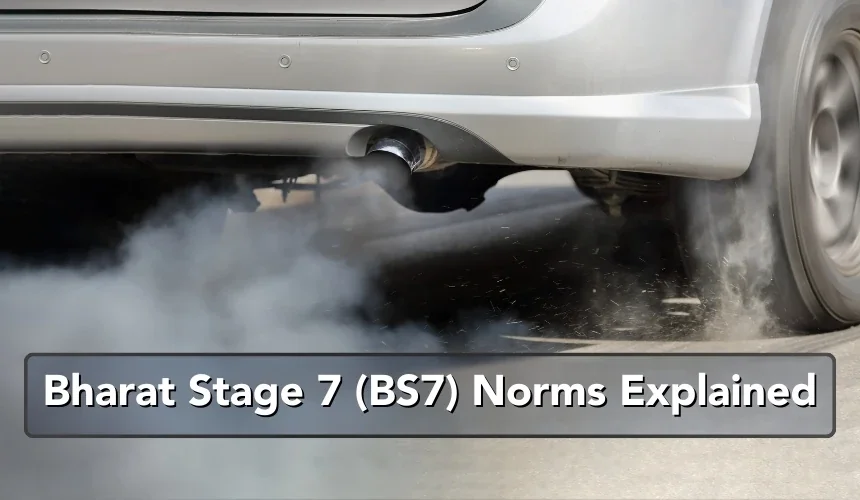
India is now prepping up for new BS7 norms, the Bharat Stage 6 is now a thing of the past with the introduction of the new one. Most recently, the European Commission announced a plan to rollout the Euro Seven norms and all the mass manufactured cars will now have to comply with a new set of rules from July 1, 2025, under 7 norms. It is yet to be officially confirmed what the norms would be but just as the BS6 was based on the Euro Six emission norms, the BS7 will be based on Euro Seven norms.
What are BS7 Norms Going to Be?
It is to be officially introduced in a few years, the BS7 will be built on the Euro Seven standard. This means that we can expect some more strict controls over the emissions from petrol and diesel vehicles. One of the standout aspects of this new norm will be the ‘On Board Monitoring’ (OBM), to monitor tailpipe emissions in real-time.
History of Emission Norms in India
It is known to everyone that vehicles are some major contributors to air pollution, and how important it is to have continuous efforts to decrease vehicular emissions. As a study conducted by an organization in Delhi on CO2 emission, it is expected that the emission of CO2 on Indian roads is likely to reach 1212 million tonnes by 2035 from 208 million tonnes in 2005.
The Automotive Industry of India is not new to this truth and has been constantly working towards controlling emissions as per the roadmap suggested by the Auto Fuel Policy. Through which, India is one of the countries in the world that manufactures the most fuel-efficient vehicles.
Let’s have a look at its history to get an idea of how it has been working:
|
Year/Period |
Key Developments in Emission Norms and Fuel Policy |
|
1991 |
Introduction of mass emission norms for petrol vehicles. |
|
1992 |
Introduction of mass emission norms introduced for diesel vehicles. |
|
April 1995 |
Introduced the mandatory installation of catalytic converters in new petrol cars in Delhi, Calcutta, Mumbai, and Chennai. |
|
2000 |
Adapted the Euro I equivalent "India 2000" norms for passenger and commercial vehicles; tight emissions norms for two-wheelers. |
|
2001 |
Euro II equivalent Bharat Stage II norms implemented in Delhi, Mumbai, Chennai, and Kolkata. |
|
August 2002 |
First Auto Fuel Policy announced, outlining the Emission and Fuel Roadmap up to 2010. |
|
April 2005 |
Implementation of Bharat Stage III norms in 13 metro cities as the rest of the country continued with Bharat Stage II norms. |
|
April 2010 |
Bharat Stage IV norms implemented in 13 metro cities; Bharat Stage III norms followed by the rest of the country. |
|
October 2014 |
Bharat Stage IV norms extended in additional 20 cities. |
|
2013 (Document Date) |
Auto Fuel Policy 2025 submitted to the Ministry of Petroleum & Natural Gas (MoP&NG), outlining a roadmap up to 2025. |
|
Proposed 2017 |
Planning for national implementation of BS IV norms. |
|
Proposed 2020/2021 |
Planned implementation of BS V emission norms. |
|
Planned 2024 (Revision to 2020) |
Introduction of BS VI norms advanced from 2024 to 2020 because of the rising pollution levels in Delhi NCR, leapfrogging towards BS V. |
What Additional Standards to Be Introduced with BS7?
The brakes and tyres also contribute to pollution, as the vehicle is in motion there are microplastics and brake dust that get discharged from them which are harmful pollutants. With the introduction of BS7 norms, control and regulation on this pollutant will be there. Also, the EVs and plug-in hybrids are to be tested strictly for longevity, and charge-holding capacity to go for over certain time periods and distances.
How much of the vehicle's emission through its lifetime will be monitored in the new norms. The vehicles under the BS7 norms are likely to come equipped with special sensors that detect issues which cause the vehicle to pollute more over time because emission levels increase as the vehicle gets old.
Challenges with BS7
To follow up with the measure under BS7 norms, manufacturers will have to make extra investments because upgrading any vehicle for the new norms would need a lot of time and capital. They will have to install an advanced emission control system to the vehicle which means that the buyers will have to pay more to get them.
For example, as last year's BS6 emission norms were implemented in the Indian automobile market, the automakers also increased their prices.
Moreover, a lot of cars could face the risk of discontinuation if not equipped with the right emission control system under BS7.
About Author

Team CarLelo
Sub-Editor

Team CarLelo is a group of passionate car enthusiasts and auto experts who bring you the latest car news, launches, reviews, and buying tips. The team focuses on simple, clear, and useful content to make car buying easy and stress-free for readers across India.
ADVERTISEMENT




























Top Car Brands in India
Trending Car News in India

 Blog
BlogNew Genesis GV90 Unveiled - Flagship Electric SUV Could Arrive in India in 2028
New Genesis GV90 flagship electric SUV unveiled with 657hp, 123.5kWh battery and futuristic features. India launch could happen around 2028.
Konica Singh
Read More
 Blog
BlogBMW i5 Long Wheelbase Revealed: Bookings Open
BMW India has revealed the soon-to-be-launched i5 Long Wheelbase, official bookings open. 669 Km range and 0-100kmph in just 6.7 seconds.
Amit Sharma
Read More
 Blog
BlogTata Motors Announces Price Hike of Up to Rs 25,000; Joins Maruti and Hyundai
Tata Motors has announced that it will increase prices across its portfolio, covering both internal combustion engine and electric vehicles, by up to 25000.
Amit Sharma
Read More
 Blog
BlogNew BMW X1 LWB Launched in India
New BMW X1 LWB launched in India at Rs 49.90 lakh with a longer wheelbase, more rear seat space, premium features and a 1.5-litre turbo petrol engine.
Konica Singh
Read More
 Blog
Blog2026 Maruti Baleno Facelift – New Engine, ADAS and CNG Automatic
2026 Maruti Baleno facelift will get Swift’s Z-Series engine, CNG automatic option, ADAS features and new updates ahead of launch.
Konica Singh
Read More
 Blog
BlogNew Volkswagen SUV Coming by 2027 – Kylaq-Based Model to Rival Venue and Nexon
Volkswagen will launch a new compact SUV in India by 2027, based on the Skoda Kylaq, with a 1.0-litre TSI engine and rivals like Venue and Nexon.
Konica Singh
Read More
 Blog
BlogKia Sorento Set for Aggressive Price Tag in India; Here’s Why?
By manufacturing the Kia Sorento locally, Kia is set to disrupt the premium 7-seater space with a high-value, feature-rich offering.
Amit Sharma
Read More


ADVERTISEMENT
ADVERTISEMENT
ADVERTISEMENT
Trending Cars in India

Trusted Dealer
All Over India

Irresistible Offers
Stay Updated, Pay Less

Compare Cars
Choose the Right Car

Easy Finance
Multiple Finance Options


Monday - Saturday

10:00am - 6:30pm

contact@carlelo.com